
The Operational Data Layer

The maritime industry is moving through a period of rapid operational and regulatory change. New requirements under EU ETS, IMO CII, FuelEU Maritime, and ongoing digitalisation initiatives across ship and port operations are reshaping how vessel owners manage their fleets. At the same time, investment is increasing in optimisation systems, performance management tools, alternative fuel capabilities, and digital port-call processes.

No single system can solve all of these challenges. Each technology, whether it is an AI-based routing tool, a fuel-efficiency retrofit, a port community integration or a compliance platform, addresses only part of the operational picture. However, they all share one fundamental dependency:
They require accurate, consistent and verifiable operational data from the vessel.
This is where many owners still face significant barriers. Noon reports vary by vessel, spreadsheets create inconsistencies, and data is often duplicated across multiple systems. When the data foundation is weak, every downstream process from emissions reporting to optimisation and charter performance claims, becomes harder, slower and less reliable.
The Ship VRS (Vessel Reporting System) does not replace the specialised tools that fleets rely on. Instead, it strengthens them by providing the structured, high-quality operational data they need to work effectively. By improving reporting discipline, standardising data formats and reducing manual errors, VRS helps fleets extract more value from the systems they already use and prepares them for the next generation of digital requirements.
Measuring what matters
Regulations have made accurate operational data a requirement rather than a preference.
For example:
- EU ETS requires verified emissions data for every voyage leg touching the EU/EEA.
- IMO DCS demands annual aggregated fuel and distance reporting, subject to verifier approval.
- CII ratings depend entirely on accurate consumption and distance metrics for each vessel.
Across all of these, the recurring issue owners report is simple:
Noon reports and spreadsheets don’t meet the standard.
How The Ship VRS helps
VRS consolidates fuel, distance, speed, weather and operational mode changes into a unified dataset. The system automatically applies regulatory formulas, flags inconsistencies, and generates reports ready for verifiers and external stakeholders. This enables owners to:
- reduce manual corrections
- demonstrate compliance with confidence
- track year-over-year efficiency
- improve transparency in charter negotiations
VRS is not a regulatory tool, but rather the operational foundation these regulatory systems require.
Regulatory pressure in maritime operations is not easing. If anything, it is accelerating. From CII and EU ETS to MRV, DCS, PFAS restrictions, ballast water requirements and new port-state digital reporting formats, the landscape is shifting faster than most operators can keep up with.
For many fleets, the real challenge is not the regulation itself, but the administrative burden that comes with interpreting, collecting, validating, and delivering the right data at the right time, as well as being able to prove compliance during audits or inspections.
The Ship VRS is designed to provide early visibility into compliance requirements by structuring operational data at the source. Instead of operators patching together data from email, spreadsheets, and manual forms (a process that almost guarantees gaps or inconsistencies), VRS ensures that required fields, calculation logic, and reporting formats are continuously updated to reflect the latest rules.
“What we consistently see across the industry is that compliance issues rarely come from the actual operations. They come from missing, inconsistent or late data. Regulations change, formats change, and interpretations change. If systems don’t adapt quickly, crews end up improvising, which increases risk. Our work with The Ship VRS is focused on staying ahead of those changes so operators don’t wake up to a new requirement they’re suddenly not prepared for. The goal is simple: prevent pitfalls from becoming findings."
Emil Pamer, CTO
By embedding regulatory logic directly into vessel workflows, rather than treating compliance as a standalone task, The Ship VRS helps owners reduce exposure to financial penalties, inefficient manual rework, and reputational risk. It also ensures that the same high-quality operational data used for compliance becomes available for other strategic needs: ESG reporting, benchmarking, performance analytics, and operational optimisation.
Improving the inputs before improving the outputs
AI-based voyage optimisation tools, trim controllers, weather routing systems and predictive maintenance platforms are becoming standard in modern fleets. However, these tools depend on high-quality input data to function correctly.
Industry studies (e.g., Wärtsilä Voyage, DNV MBE reports) consistently note that poor reporting quality is a major barrier to extracting value from digital systems.
How The Ship VRS helps
VRS standardises the key operational datasets:
- timestamps
- positions
- fuel and engine metrics
- cargo and draft information
- power and auxiliary consumption
This structured dataset integrates cleanly into optimisation platforms. As a result, AI tools deliver more accurate predictions, more reliable recommendations and more meaningful performance analysis. VRS does not position itself as an AI solution, but it enables AI to work at its intended level.
Reducing risk through standard processes
As vessels adopt more connected systems, the use of ad-hoc reporting (Excel files, email attachments, USB transfers) has become both inefficient and a recognised cyber risk.
IMO’s Guidelines on Maritime Cyber Risk Management (MSC-FAL.1/Circ.3) emphasise the importance of controlling information flows between ship and shore.
How The Ship VRS helps
VRS provides a secure, centralised channel for operational data. it allows companies to phase out unstructured email-based reporting, uncontrolled file transfers and redundant data entry across multiple systems. This improves both cyber resilience and operational discipline, without increasing workload for the crew.
“High-quality operational data is only valuable if it is also securely handled. When reports move through uncontrolled channels, you don’t just risk inaccuracies, you also risk compromising the integrity of the entire operational picture. Our goal with VRS is to give owners data they can trust and a secure pathway for moving that data between ship and shore.”
Fredrik Lerøy, CEO
Building a reliable operational timeline
Before remote or semi-autonomous operations become widespread, vessels must provide consistent logs and verified operational status information. Current remote-assistance pilots (e.g., Kongsberg’s Yara Birkeland project, NYK’s crewless operations tests) highlight the need for:
- structured event reporting
- consistent timestamps
- clear operational segmentation (sea passage, manoeuvring, port stay, waiting time)
How The Ship VRS helps
VRS already captures these event structures by design. This creates a dataset that is suitable for future remote operations use cases, even if the vessel is still fully crewed today.
Owners investing in autonomy-readiness can adopt VRS without needing new hardware, sensor systems or complex integrations.
Connecting ship, shore and terminal
Port congestion and waiting times remain major cost drivers. Industry initiatives such as the IMO Just-In-Time Arrival Guide, Port of Rotterdam’s Port Call Optimisation Taskforce, and the Digital Container Shipping Association’s standardisation work all emphasise that vessels must provide standardised, reliable and timely port-call data.
How The Ship VRS helps
With the upcoming Port Reporting and Scheduling System, The Ship extends VRS into:
- ETA updates
- berth schedule integration
- port call event logging
- time-stamp standardisation (arrival, pilot, gangway down, all fast, etc.)
This aligns vessel reporting with modern port-community and terminal expectations.
It also reduces idle time, improves transparency, and supports just-in-time operational planning.
What sets The Ship VRS apart
While many maritime systems aggregate, display or analyse data, The Ship VRS focuses on a more fundamental question:
Is the underlying data correct, standardised and useful across reporting, compliance, optimisation and commercial workflows?
This focus results in several practical advantages:
Crew-friendly design
The system is built around simple workflows, not large technical interfaces. This reduces reporting fatigue,a key reason data quality improves.
Integrated, not intrusive
VRS works alongside existing systems (PMS, optimisation tools, chartering platforms), acting as the operational “source of truth” rather than replacing established processes.
Strong reporting discipline
Standardised forms, validation rules and automated checks raise the quality of daily reporting without additional workload.
Regulatory alignment
By structuring data according to MRV, CII, DCS and ETS requirements, VRS removes ambiguity and reduces compliance risk.
Scalable and fleet-wide
Whether an owner has five vessels or fifty, the system provides a unified operational dataset that can scale without re-engineering.
“The real strength of The Ship VRS is that it naturally bridges areas that are often treated separately: operations, compliance, performance and commercial reporting. It connects these functions through one consistent data flow, which is where many fleet systems struggle. At the same time, VRS stands firmly on its own. Even without integrations or add-ons, it provides immediate value by improving data quality and making day-to-day reporting more reliable for both ship and shore.”
Øystein Farsund, Director of Business Development
Conclusion
The Ship VRS occupies a clear and increasingly important niche in maritime digitalisation:
it provides the operational data foundation upon which modern fleet management depends.
It is not a fuel-savings tool, optimisation algorithm, or compliance engine, but it makes all of those tools more accurate, more reliable and more valuable. It enables vessel owners to extract real benefits from the technologies they invest in, while reducing the operational burden on crew and shore staff.
In a market full of complex systems, The Ship VRS stands out as a best-of-breed reporting platform, focused, practical and essential. It consistently delivers more value than the label “reporting system” suggests, and it addresses core challenges that, if left unresolved, undermine the impact of every other digital initiative.

The Cost of Untrusted Data
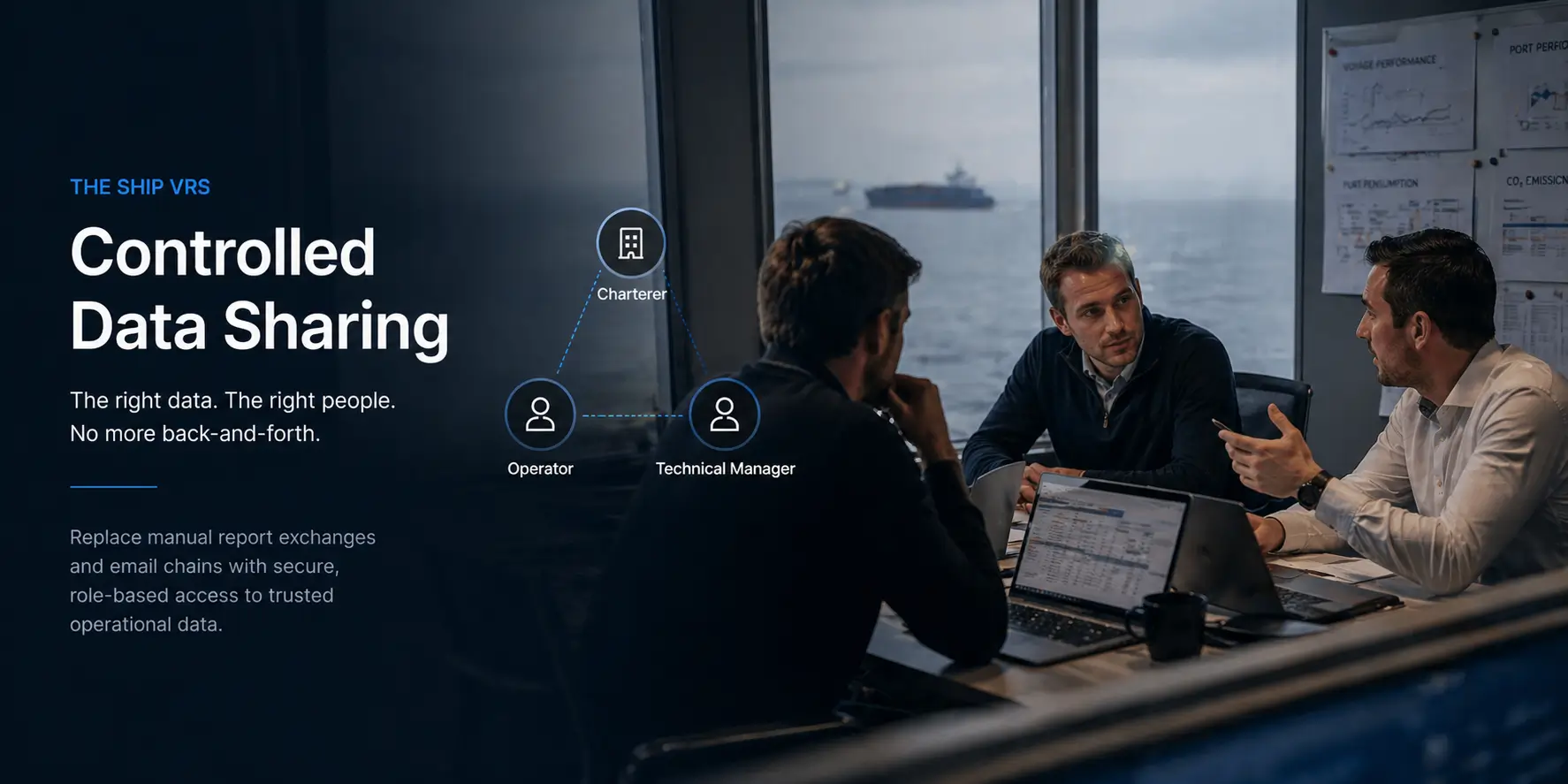
Introducing Controlled Data Sharing

5 Questions Every Shipowner Should Ask About Their Reporting System
Get in touch
Have any questions about The Ship VRS? Don't hesitate to reach out to our sales team.