
The Cost of Untrusted Data

Maritime data quality is an operational matter, not simply an IT matter.

Shipping companies collect substantial amounts of operational data: positions, timestamps, fuel consumption, cargo activity, port events, emissions figures and voyage information.
Much of this information moves between vessels, shore organisations and external stakeholders. It is used for operational follow-up, commercial decisions, regulatory reporting and performance analysis.
The value of the data depends, however, on whether it is consistent and reliable.
When information is entered differently across vessels, stored in separate systems or exchanged through spreadsheets and email attachments, several versions of the same event can emerge. Each version may appear reasonable in isolation, but differences become visible when the information is compared or used for another purpose.
This creates practical consequences:
- Time is spent checking and correcting reports
- Operations teams follow up missing or inconsistent information
- Commercial teams reconstruct voyage and port events
- Compliance teams need to clarify whether data is complete
- Management receives information that may require further verification
These are not primarily technical problems. They affect the daily operation of the company and the confidence people can place in its data.
One event, several records
A vessel’s arrival at port is a straightforward example.
The time of arrival may be recorded in the vessel’s arrival report, the agent’s statement of facts, an AIS record, an operational spreadsheet and a message sent to the charterer. These records do not always correspond.
A small difference may have limited importance on its own. Across several events, voyages and vessels, however, inconsistencies accumulate. They can affect voyage analysis, port-performance reviews, emissions reporting, laytime calculations and commercial discussions.
They also create a basic question: which record should be used?
Answering that question often requires someone to return to the source material, compare documents and determine which information is correct. This may happen days or weeks after the event, when the operational context is no longer readily available.
A better approach is to identify and resolve inconsistencies while the information is still current.
Data quality starts with collection
Reliable analysis depends on how the underlying information is collected.
Vessel reporting therefore requires consistent definitions, structured reporting processes and appropriate validation. The system should help users identify missing information and discrepancies at the time of reporting—not only when the data is later used for analysis, compliance or a commercial claim.
This should not result in more administrative work for the crew.
The reporting process should be clear and practical, with validation built into the workflow. The objective is to make accurate reporting easier onboard while providing the shore organisation with timely visibility of the information received.
The sequence is relatively simple:
Collect consistently. Validate early. Analyse in context. Share with control.
Each stage depends on the quality of the previous one.
Establishing one operational record
At The Ship, we work from the principle that vessel and shore organisations should operate from the same underlying information.
The Ship VRS provides a common operational data layer for vessel reports, voyage events, port calls, cargo activity, fuel consumption and compliance information. The purpose is to maintain continuity from the initial reporting onboard to the subsequent use of the data ashore.
This is more than replacing paper forms or spreadsheets with digital reporting.
The information collected for one purpose should, where relevant, also support other operational and commercial workflows. The same validated data can then be used across areas such as:
- Fleet and voyage monitoring
- Noon, arrival and departure reporting
- Port-call and cargo follow-up
- Emissions and regulatory reporting
- Voyage and vessel-performance analysis
- Statements of facts and laytime calculations
- Collaboration with approved external stakeholders
This reduces the need to re-enter, reinterpret or reconcile the same information each time it is used.
It also provides a clearer basis for reviewing changes, identifying the source of a figure and understanding how the information has been handled.
Sharing data requires control
Shipping operations depend on cooperation between several parties. Owners and operators regularly share information with charterers, cargo owners, commercial managers, agents, verifiers and other partners.
In many cases, this is still handled through exported reports, spreadsheets and email attachments. These methods are familiar and sometimes sufficient, but they also have limitations.
A file represents the information at the time it was created. It may subsequently be changed, forwarded or replaced by a newer version. The sender has limited control over how long it remains in circulation or whether all recipients are working with the same information.
Providing external parties with broad access to an internal system is not necessarily a suitable alternative. Different stakeholders have different roles and information requirements.
The relevant question is therefore not only whether data can be shared, but whether the organisation can determine:
- Which information is made available
- Who receives access
- What the information may be used for
- How long access should remain available
In practical terms, this means sharing the right data with the right stakeholder for a defined purpose.
Controlled Sharing in The Ship VRS
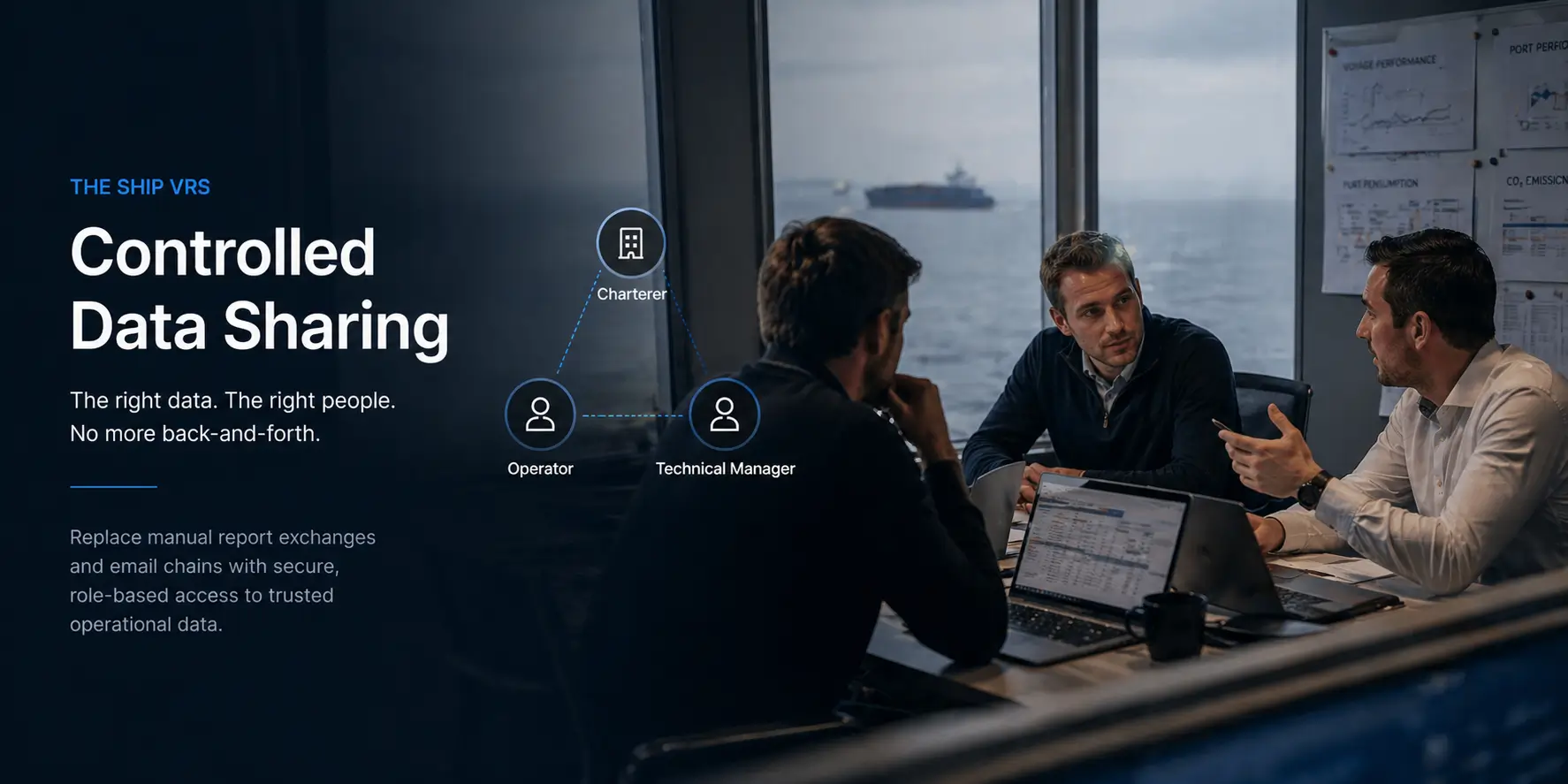
Controlled Sharing allows owners and operators to provide approved stakeholders with access to selected operational information while retaining control of the underlying data.
The access can be adapted to the recipient’s role and requirements.
A charterer may require specific voyage and cargo information. A verifier may need emissions data and relevant supporting records. A commercial partner may need access to agreed port-call events. Internal teams may require a broader operational overview.
These parties do not necessarily need access to the same information or to the complete operational system.
By giving stakeholders access to selected, current data, Controlled Sharing can reduce the need for parallel spreadsheets and repeated distribution of static files. The information remains connected to its operational source and can be viewed within the appropriate context.
This provides a more structured basis for collaboration, while the owner or operator retains control over access.
A foundation for automation
The maritime industry is making increasing use of automation, analytics and artificial intelligence. These tools may reduce manual work and provide better operational support, but their usefulness depends on the quality of the underlying data.
Automation cannot resolve unclear definitions by itself. Analysis based on inconsistent records will remain uncertain, regardless of how it is presented. AI may identify patterns and anomalies, but it also requires structured and dependable input.
Before introducing additional layers of analysis or automation, it is therefore useful to consider a few basic questions:
- Where does the operational data originate?
- Is it collected consistently across the fleet?
- When and how is it validated?
- Are departments working from the same information?
- Can external access be limited to relevant data?
- Can the information be traced back to its operational source?
These questions are not new, but they are becoming more important as operational data is used across a wider range of commercial, regulatory and technical processes.
From reporting requirement to operational resource
Vessel reporting has traditionally been regarded as an administrative requirement. Information is collected because it is needed by the shore organisation, a commercial counterparty or a regulatory authority.
When the information is collected consistently and managed properly, it can also serve as a practical operational resource.
It can provide a common basis for decisions, reduce uncertainty between departments and stakeholders, and support further automation. It can also allow information to be shared without giving recipients broader access than necessary.
The objective is not to collect more data.
It is to make better use of the data already being collected—and to ensure that it can be trusted when it is needed.
Trusted data. Shared with control.
The Ship VRS helps owners and operators establish a consistent operational data flow—from reporting onboard to analysis, compliance and controlled collaboration with external stakeholders.
To discuss how Controlled Sharing could support your existing workflows, contact us or request a walkthrough at theship.io.
The Cost of Untrusted Data
Introducing Controlled Data Sharing

5 Questions Every Shipowner Should Ask About Their Reporting System
Get in touch
Have any questions about The Ship VRS? Don't hesitate to reach out to our sales team.